CHAKRA-AI: Autonomous Agent Platform
End-to-end automation of complex personnel assignment workflows. Natural-language commands drive multi-step AI reasoning, candidate ranking, and a structured approval chain — all running fully offline.
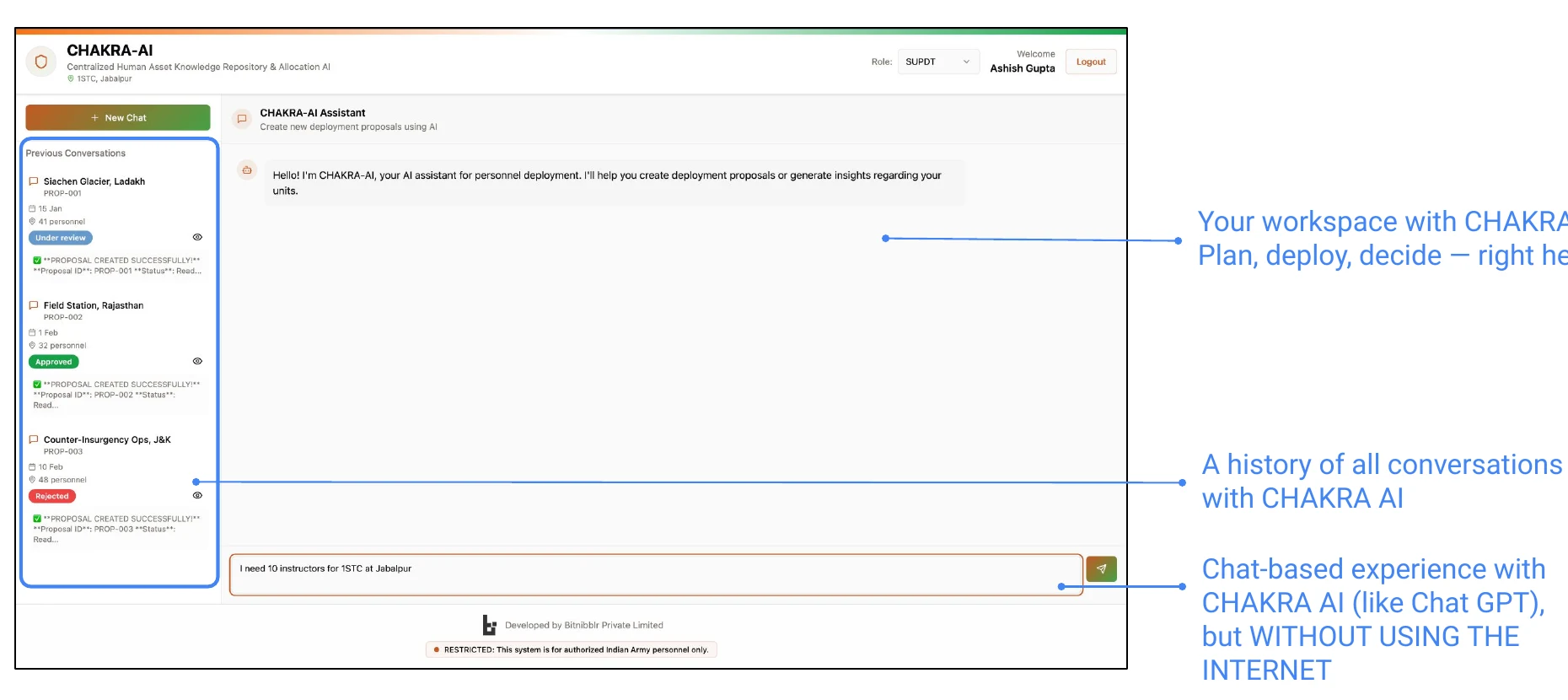
CHAKRA-AI main workspace: past proposals in the sidebar, AI assistant in the main panel, prompt bar at the bottom
Large organisations managing personnel across distributed locations rely on manual processes, Excel-based data shuttling, and disconnected record systems for complex assignment workflows. Every stage requires manual verification against multiple sources, offers no intelligent recommendations, and creates bottlenecks that compound across the organisation. Existing systems make it impossible to ensure consistent, merit-based decision-making at scale without a team of analysts working in parallel.
Built CHAKRA-AI, a fully offline autonomous agent platform with a conversational interface. A plain-language request triggers the AI reasoning engine, which queries multiple personnel data sources simultaneously, applies configurable suitability criteria across the entire candidate pool, and generates a ranked shortlist with written rationale for each candidate. The proposal then routes automatically through a role-based approval chain, with every action timestamped and immutably logged. No form-filling, no Excel sheets, no manual verification at any stage.
Natural language command interface
Issue requests in plain language. The system interprets the requirement, confirms scope, and begins autonomous multi-step processing without any form-filling or manual data entry. Each reasoning step surfaces in real time so progress is always visible.
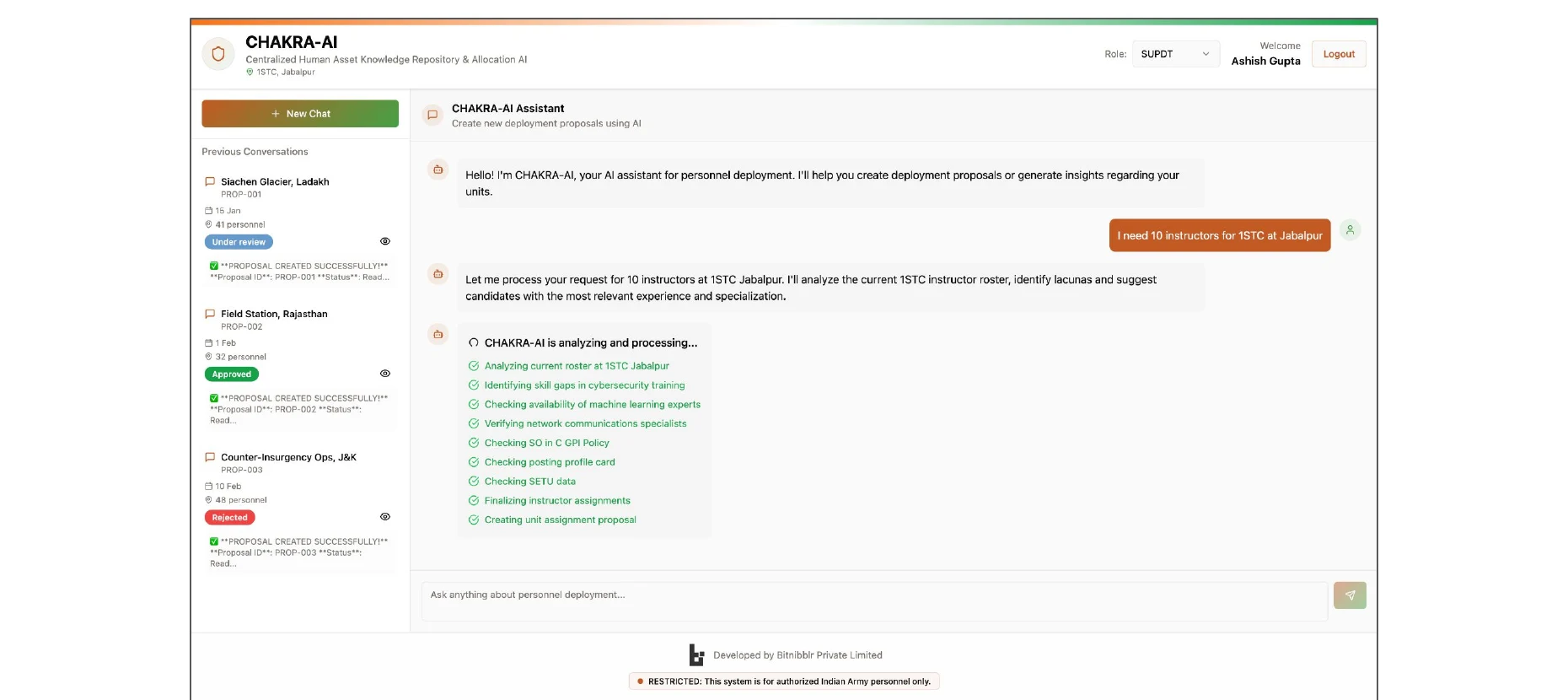
Key Capabilities
- Natural language query parsing with intent classification
- Multi-turn conversation history across past proposals
- Step-by-step reasoning progress across up to 8 concurrent analysis steps
- Concurrent tracking of multiple proposals across different locations
- Fully offline — no internet dependency at any point
- Single unified interface for all role types: SUPDT, Records, OIC
Multi-source analysis and suitability scoring
Draws from multiple personnel record systems simultaneously, evaluating candidates against configurable suitability criteria. Each candidate is tagged Suitable or Unsuitable with a written AI-generated rationale attached — no human triage required at any point in the shortlisting process.
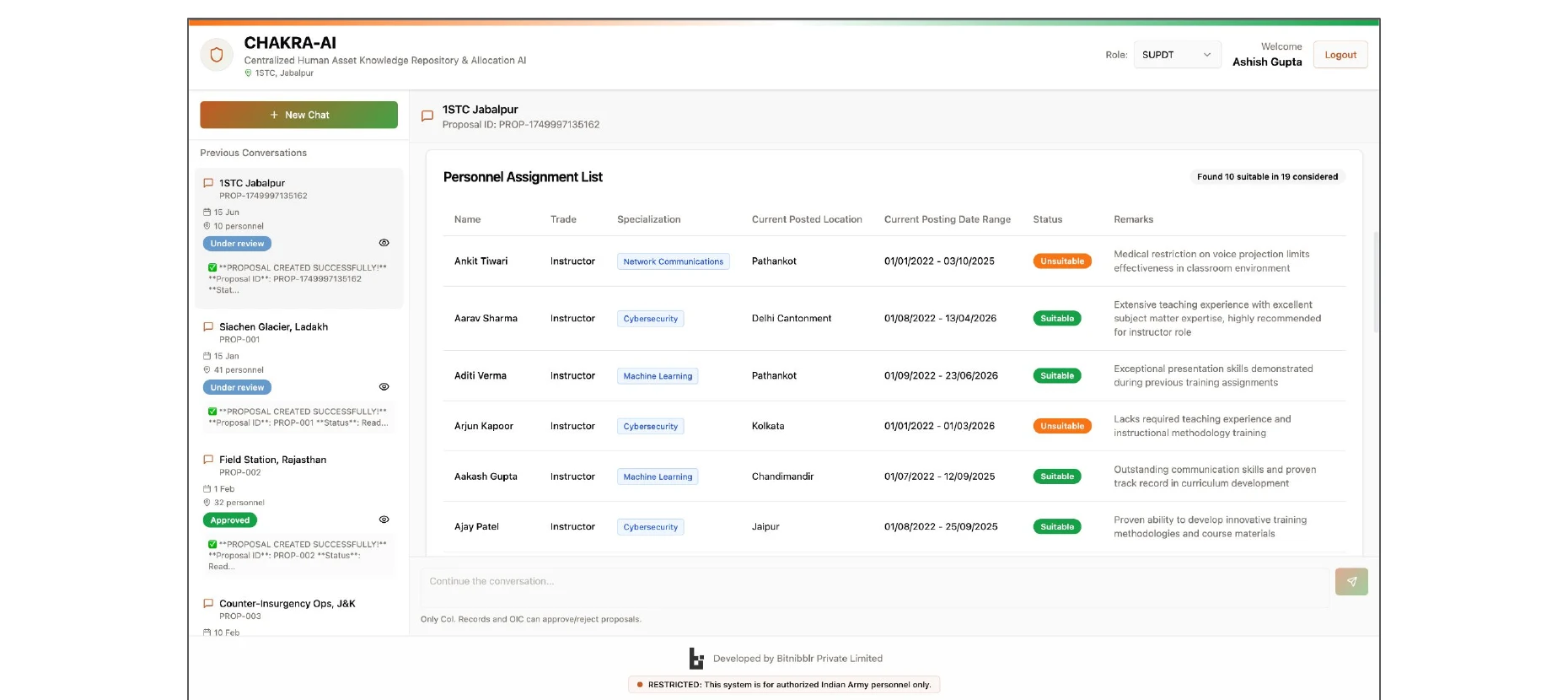
Key Capabilities
- Multi-source data fusion across disconnected record systems
- Suitability scoring with written rationale per candidate
- Configurable ranking criteria per proposal type
- Automatic disqualification flagging with documented reason
- Full candidate pool scanned before shortlist is presented
- Specialisation, availability window, and performance factored simultaneously
Structured approval with full audit trail
Proposals route automatically through a configured approval hierarchy. Each approver reviews the AI's full analysis and attaches remarks before passing to the next stage. Every action is timestamped, signed, and immutably logged — no external audit tool required.
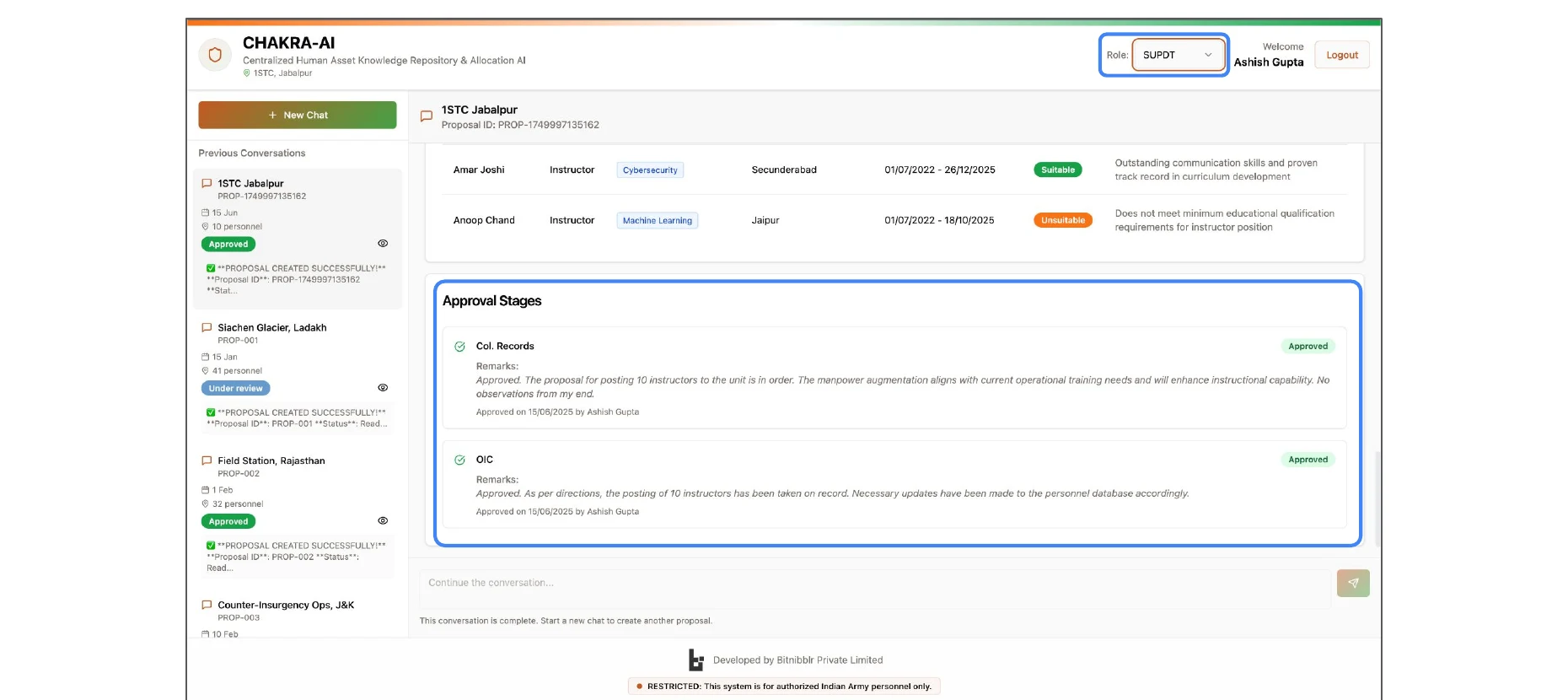
Key Capabilities
- Role-based access across SUPDT, Records, and OIC roles
- Sequential approval gates with mandatory remarks at each stage
- Timestamp and officer ID recorded on every approval or rejection
- Complete immutable audit history retained per proposal
- Final approved state triggers automatic record update
- All overrides tracked with reason, timestamp, and identity
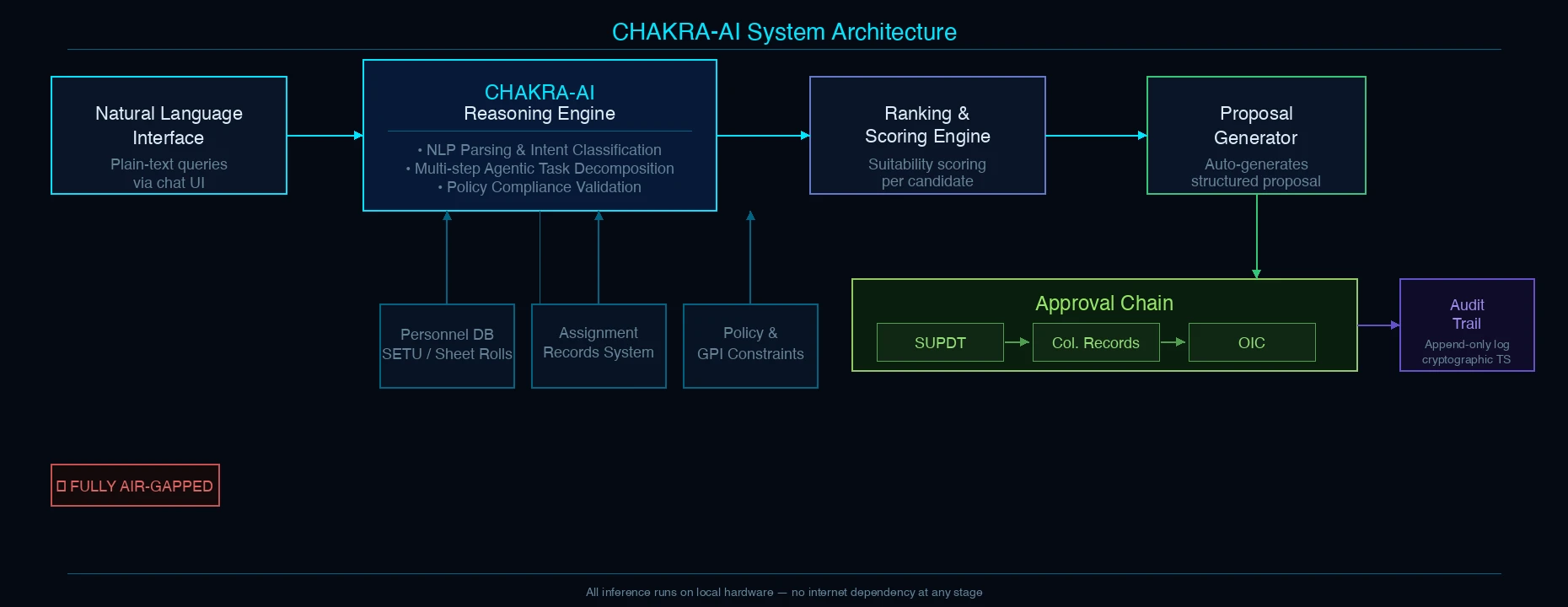
- Fully air-gapped LLM inference: the reasoning engine runs entirely on local hardware, requiring model quantisation and prompt engineering tuned for constrained compute without cloud offloading.
- Multi-source data fusion across heterogeneous record systems with inconsistent schemas — normalisation and conflict resolution handled at the retrieval layer before any ranking occurs.
- Configurable ranking criteria: each proposal type carries a different weighting profile applied simultaneously to specialisation match, availability window, posting history, and performance indicators.
- Role-based access control with concurrent sessions — multiple users across different role types can access the same proposal simultaneously without state corruption or race conditions.
- Immutable audit trail design: every agent action, user approval, and override is appended to an append-only log with a cryptographic timestamp, preventing post-hoc modification of the record.
- Context window management across long multi-step reasoning chains — the agent decomposes large requests into parallelisable sub-tasks to stay within inference limits while maintaining coherence across steps.