Aegis: Counter-UAS Interception & Drone Defence System
Multi-modal threat classification with sub-second sensor cross-cueing latency. Four integrated layers — sensor array, fusion engine, AI classification, and C2 — unified as a full counter-UAS interception platform with autonomous soft-kill sequencing.
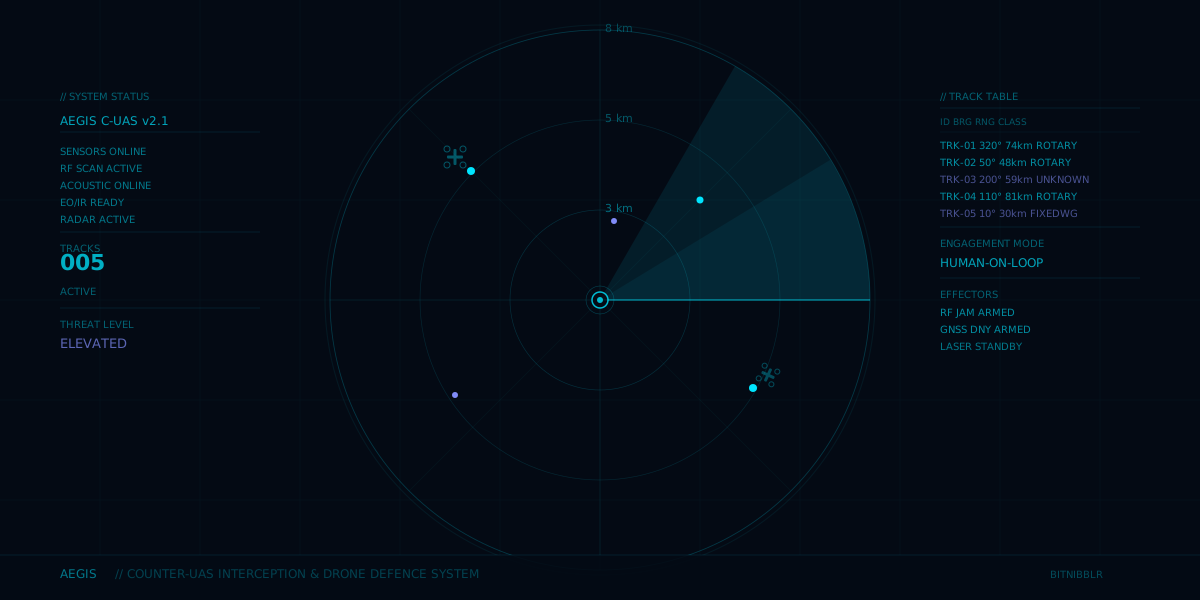
Aegis C2 display — five active tracks across the monitored airspace, engagement mode set to human-on-the-loop
Commercially available drones — FPV platforms built from non-metallic materials, flying below conventional radar floors at sub-10 m altitude — have near-zero radar cross-section and carry no GPS signal to exploit. Legacy static sensor networks generate alert-to-action timelines measured in minutes. Coordinated swarms saturate finite interceptor inventories. Autonomous AI-guided platforms carry no detectable RF control link. Each of these threat categories defeats a different element of conventional perimeter defence, and the operational requirement is to address all of them simultaneously from a single platform without generating the false-positive rate that destroys operator trust in automated systems.
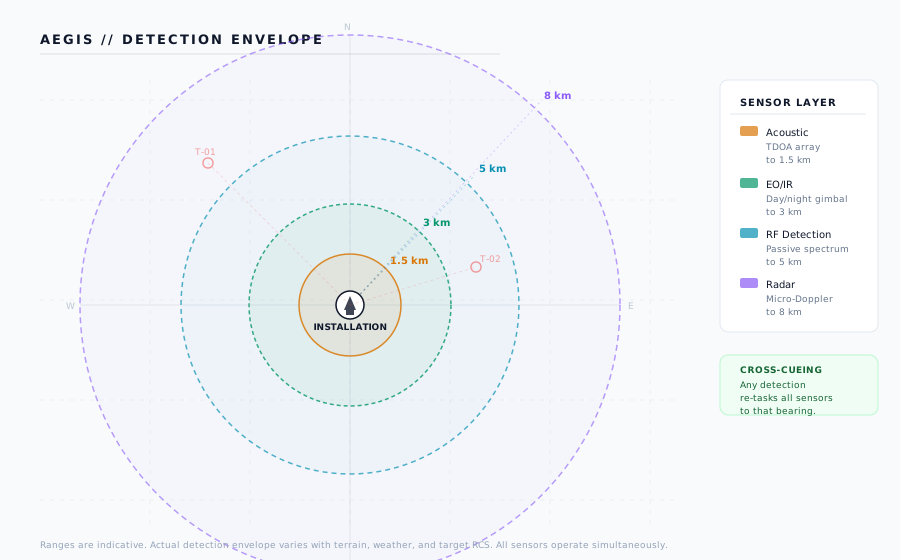
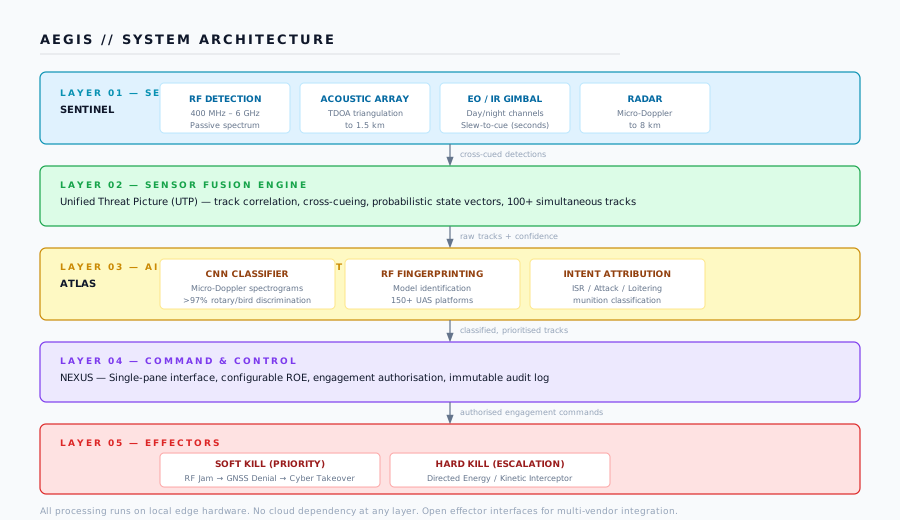
Built Aegis as a four-layer architecture. The SENTINEL sensor array integrates passive RF spectrum monitoring across 400 MHz–6 GHz, a TDOA microphone array for acoustic triangulation, an EO/IR gimbal with day/night channels that slews to cue within 1.2 seconds of any detection event, and a micro-Doppler radar tuned for low-RCS small UAS signatures. Detections from any sensor cross-cue the others immediately, producing a fused track within seconds of first contact. ATLAS, the AI classification engine, runs a CNN pipeline on radar micro-Doppler spectrograms to distinguish drones from birds, and applies RF fingerprinting against a reference library of 150+ commercial UAS platforms for model-level identification. Intent attribution then classifies each track as an ISR platform, attack drone, or loitering munition based on altitude profile and heading relative to protected assets. NEXUS, the C2 layer, presents the full threat picture on a single operator interface and manages the engagement sequence — soft-kill first, hard-kill only when operationally required.
SENTINEL
Multi-Modal Sensor Array
SENTINEL forms the detection backbone — four heterogeneous sensor modalities operating simultaneously and cross-cueing each other in real time. No single sensor covers the full UAS threat spectrum: RF monitoring misses autonomous platforms with no control link; radar struggles against non-metallic FPV airframes; acoustic arrays are range-limited. SENTINEL treats the combination as the detection unit, not the individual sensor.
Key Capabilities
- Passive RF spectrum monitoring, 400 MHz–6 GHz, covering drone control and telemetry bands
- TDOA microphone array: acoustic triangulation of motor and propeller signatures to bearing and range
- EO/IR slew-to-cue: gimbal repositions within seconds of any radar or RF detection event
- Micro-Doppler radar: rotary-wing vs. bird discrimination at >97% classification accuracy
- Simultaneous tracking of 100+ independent targets across the sensor network
- Cross-cueing architecture: any detection immediately re-tasks all sensors to that bearing
ATLAS
AI Classification & Threat Attribution
Raw sensor tracks enter ATLAS as noisy probability distributions. A multi-stage AI pipeline refines each track from first detection through to intent attribution before anything reaches the operator interface. The pipeline is designed to minimise both false positives — unnecessary intercepts — and false negatives — missed threats. Confidence thresholds at every stage route uncertain classifications to human review rather than autonomous action.
Key Capabilities
- CNN classifier trained on radar micro-Doppler spectrograms for rotary/fixed-wing/bird discrimination
- RF fingerprinting for drone model identification across 150+ commercial UAS platforms
- Intent classification: ISR platform, attack drone, logistics drone, loitering munition
- Swarm detection: individual member track management under electronic countermeasure conditions
- Confidence-weighted output: low-confidence tracks escalate to human review, not autonomous action
- Priority queue: continuously updated threat ranking as new sensor data arrives
NEXUS
Command, Control & Effector Orchestration
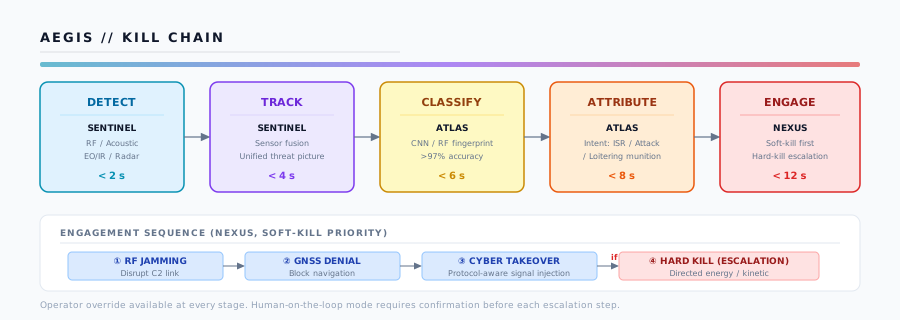
NEXUS is the decision and action layer. Every sensor track, classification state, and effector status converges into a single operator interface. The engagement philosophy is soft-kill first: RF jamming disrupts the control link, GNSS denial blocks navigation, protocol-aware cyber takeover commandeers the target. Hard-kill is a last resort when non-kinetic options are exhausted or rules of engagement require it.
Key Capabilities
- Single-pane-of-glass interface: real-time track confidence, classification state, and threat vector
- Configurable engagement modes: manual initiation, semi-autonomous, and fully autonomous
- Soft-kill sequencing: RF jamming → GNSS denial → RF cyber takeover (protocol-aware signal injection)
- Hard-kill coordination: kill zone deconfliction for collateral damage avoidance
- Every engagement action attributed, timestamped, and retained in an immutable log
- Open architecture: standardised effector interfaces for multi-vendor countermeasure integration
- Low-RCS target acquisition for non-metallic FPV airframes at operationally relevant ranges — radar systems tuned for conventional aircraft miss these targets entirely; waveform and signal processing adaptation is specific to small, slow, low-altitude UAS.
- Multi-sensor track correlation under active electronic countermeasures — adversarial jamming degrades individual sensors selectively; the fusion engine must maintain track continuity using whichever modality remains unaffected.
- Intent attribution before the engagement window closes — at typical drone speeds and intercept ranges, the system has 8–15 seconds from first reliable detection to engagement initiation; classification must complete within that window.
- Swarm track management under saturation pressure — coordinated multi-drone attacks are designed to exhaust interceptor magazines and overwhelm operator attention; the system must maintain per-target tracks and prioritise engagement order autonomously.
- Protocol-aware cyber takeover without triggering failsafe return-to-home — injecting spoofed control signals requires timing the injection precisely to the target drone's control loop frequency; mis-timing triggers the very failsafe the operation is trying to avoid.
- Autonomous engagement with fail-safe constraints — fully autonomous soft-kill modes require hard limits on effector activation radius, minimum classification confidence thresholds, and per-effector enable/disable controls accessible to the operator at any point in the engagement chain.